
Analysis of the causes of pressure fluctuation, vibration, and noise in centrifugal pumps: field experience from Jiangsu Haifa
2026-06-24 06:34:09 211 江苏海珐In petrochemical plants, many pump issues don’t start with an instrument alarm—they start with sound. Operators will say, “ pump sounds off,” “The discharge pressure is a bit unsteady,” “The mechanical seal temperature is higher than before,” or “The vibration is worse than last month.” Behind these phenomena, the causes are often related to pressure pulsation, cavitation noise, low-flow operation, gas entrainment at the suction, or impeller wear.
Abroad, there’s plenty of research on centrifugal pump pressure pulsation, cavitation noise, and rotor-stator interaction, mainly focusing on unsteady flow between the impeller and volute, pressure fluctuations under off-design conditions, and the impact of cavitation formation and collapse the pump. To users, these studies may seem academic, but on the shop floor, it all boils down to whether the pump can run quietly, stably, and for the long haul.
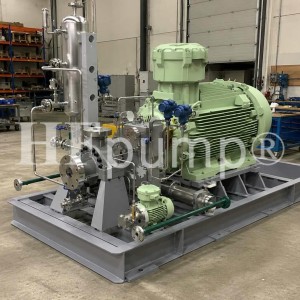
At Jiangsu Haifa, when we manufacture API 610 chemical process pumps, we always emphasize not letting the pump operate far from its rated point for extended periods. Running a centrifugal pump near its design point keeps efficiency, vibration, radial force, and pressure pulsation relatively stable. If it runs at low flow for too long, recirculation, vortices, temperature rise, and pressure fluctuations can occur inside the impeller. If it runs at high flow for too long, the risk of cavitation and shaft power load increases.
Pressure pulsation typically comes from several sources. First, the periodic pressure change as impeller blades pass the volute tongue. Second, degraded internal flow patterns under off-design conditions, leading to recirculation and flow separation. Third, gas entrainment or cavitation at the suction, causing bubble formation and collapse, which generates noise and impact. Fourth, unreasonable piping system or valve openings causing system fluctuations. Fifth, impeller wear, enlarged wear ring clearances, or rotor imbalance, which worsen both pressure and vibration.
Jiangsu Haifa’s API 610 OH1/OH2 HES series chemical process pumps cover a flow range of 2–2600 m³/h, head up to 300 m, temperature range of -80 to 450°C, and design pressure of 2.5–26 MPa. This series features horizontal, radially split, single-stage overhung centrifugal pumps, suitable for refineries, petrochemicals, coal chemicals, cryogenic applications, and offshore industries. For conventional petrochemical process pumps, the OH2 design is mature, easy to maintain, and a foundational pump type for many plants.
For heavier duty, higher pressure, higher temperature, or longer continuous operation requirements, the BB2 is a better fit. The BB2 has a flow range of 50–4000 m³/h, head up to 650 m, temperature range of -80 to 450°C, and design pressure of 5.0–15.0 MPa. Its between-bearings, centerline-supported design better handles high temperature, high pressure, heavy-duty, and continuous operation.
For high-head multistage pumps, pressure pulsation and rotor stability demand even more attention. The BB3 series can achieve heads up to 3000–3200 m, with a maximum design pressure of 35 MPa. The BB4 series can achieve heads up to 1000 m, with a design pressure of 15 MPa. If these pumps operate too far from their design point or under unstable suction conditions, the resulting vibration and pressure fluctuations can affect bearings, seals, and piping.
When troubleshooting pressure pulsation and cavitation noise in the field, I generally recommend a step-by-step check. Start with the suction side: Is the liquid level sufficient? Is the suction valve opening correct? Is the strainer clogged? Is there gas trapped at high points in the suction line? Has the medium temperature increased? Then check the operating point: Is the pump running at low flow for extended periods? Is the discharge valve throttled too much? Is it below the minimum continuous stable flow? Next, inspect the mechanical side: coupling alignment, foundation, bearings, impeller wear, wear ring clearances, and rotor balance. Finally, look at the system: piping supports, valve arrangement, check valves, water hammer risks, and bypass line setup.
Often, pump noise isn’t caused by a single factor. For example, a clogged suction strainer reduces NPSHa; lower NPSHa causes cavitation; cavitation leads to pressure pulsation; pressure pulsation intensifies vibration; and vibration affects mechanical seal life. So we can’t just treat the surface symptoms—we need to look at both the process conditions and the pump itself.
In my view, the value of an API 610 chemical process pump isn’t just moving fluid from point A to point B. It’s about controlling flow, head, sealing, vibration, and safety in high-temperature, high-pressure, corrosive, flammable, explosive, and continuous-operation environments. If a pump starts sounding louder, you don’t necessarily have to shut it down immediately, but you can’t ignore it. Early analysis often prevents much higher maintenance costs down the road.
rifugal pump pressure pulsation, cavitation noise, API 610 chemical process pump, pump vibration, minimum continuous flow, OH2 centrifugal pump, BB2 petrochemical pump, BB3 multistage pump, mechanical seal, pump pressure pulsation, cavitation noise, API 610 centrifugal pump, chemical process pump vibration
上一篇:Examining the vibration, cavitation, and predictive maintenance of API610 chemical process pumps from foreign research perspectives 下一篇:Application of Lingsheng supercomputer in remote automatic control of water pumps: Technical considerations for Jiangsu Haifa API610 chemical process pumps
Jiangsu Haifa Machinery Manufacturing Co., Ltd.
📍 Headquarters: Jingjiang Economic and Technological Development Zone, Jiangsu Province (Yangtze River Delta Ecological Green Integration Demonstration Zone, Jingjiang Park)
📞 Hotline: (086)13905263417 & (086)13908365805
📠 Fax: (086)0523-84323581
📧 Email: jsareva@163.com jslgpump@gmail.com
🔧 Technical Support: One-stop service for pump & valve customization, non-standard design, on-site surveying, maintenance and repair
Member of China General Machinery Industry Association | Director of Valve Association | SINOPEC Resource Market Member Factory

Get QR Code