
Selection of 350℃ heat transfer oil pump: How to choose between API610 BB2 pump and OH2 pump?
2026-07-01 19:57:10 646 江苏海珐In high-temperature heat transfer oil systems, the selection of a 350°C high-temperature heat transfer oil pump cannot be based solely on temperature. Many customers directly ask during consultations: For 350°C heat transfer oil, should we use an API610 BB2 pump or an API610 OH2 pump? From our experience at Jiangsu Haifa Machinery Manufacturing Co., Ltd. in manufacturing API610 chemical process pumps, the temperature of 350°C does not directly determine the pump type. What truly influences the selection of a high-temperature heat transfer oil pump are flow rate, head, design pressure, medium viscosity, continuous operation requirements, pipeline thermal expansion, mechanical seal scheme, and shaft system stability. For ordinary heat transfer oil circulation systems with low flow rates and heads, an API610 OH2 pump can typically meet the requirements. For critical conditions involving large flow rates, high temperatures, and continuous operation—especially scenarios with a flow rate of 1800³/h and a head of 110m—we recommend prioritizing an API610 BB2 double-suction, between-bearings pump. This article will analyze the selection of 350°C heat transfer oil pumps, API610 pump selection, and the applicable scenarios for BB2 and OH2 pumps from a technical selection perspective.
Why can't the selection of a 350°C heat transfer oil pump be based only on temperature?
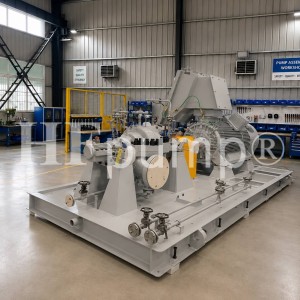
heat transfer oil operates around 350°C it may not necessarily be a highly corrosive medium, but imposes high demands on the pump's structural stability, mechanical seals, bearing cooling, and thermal expansion control. At this temperature, the pump casing, base, piping, coupling, and seal chamber are all affected by thermal operation. Selecting a pump solely based on a "temperature of 350°" can easily overlook issues such as vibration, seal leakage, bearing temperature rise, and coupling alignment during later operation. When selecting a high-temperature heat transfer oil pump, we typically focus on confirming the following parameters: Medium name: Heat transfer oil thermal oil, synthetic heat transfer oil, or other high-temperature thermal oil media Operating temperature: 350°C Flow rate Q: 1800m³/h Head H: 110m Medium density: 0.85 Operating viscosity: 8 Net positive suction head available (NPSHa): 6m Continuous operation Significant thermal expansion in on-site piping, part of a petrochemical thermal medium main circulation key unit. Therefore, the selection of a 350°C high-temperature heat transfer oil pump cannot be simplistically understood as "high temperature requires BB2." If the flow rate is small, head is moderate, and the unit is not a heavy-duty application, an OH2 pump can serve as an economical solution. However, if the flow rate is large, power is high, and continuous operation requirements are stringent, the reliability of a BB2 pump offers greater advantages.
Structural comparison between API610 OH2 and BB2 pumps
Both OH2 and BB2 pumps are common petrochemical process pump structures under the API610 standard Both can be used for high-temperature medium transport, but their structural positioning differs. Comparison item | API610 OH2 pump | API610 BB2 pump Structural form | Horizontal, centerline support, single-stage overhung centrifugal pump | Horizontal, radially split, between-bearings centrifugal pump Support method | Overhung support | Between-bearings support Applicable conditions | Small to medium flow rates, medium heads, high-temperature chemical processes | Large flow rates, high, high heads, continuous operation, heavy-duty applications -temperature stability | Requires focused control of shaft deflection, seals, and thermal expansion | Better shaft system rigidity, more suitable for high-temperature continuous operation Maintenance features | Relatively simple structure, easy maintenance, lower cost | Heavier structure, higher manufacturing and maintenance costs, but stronger reliability Suitable for °C heat transfer oil? | Usable for moderate conditions | Prioritized for large flow rates and heavy-duty conditions Structurally, OH2 pumps are not unsuitable for 350°C heat transfer oil; rather, it depends on whether they suit the flow rate, head, and operational intensity of the condition. The advantage of BB2 lies in their more stable between-bearings structure, making them more suitable for API610 pump selection scenarios involving large flow rates, high temperatures and continuous operation.
When can an API610 OH2 high-temperature heat oil pump be chosen?
If the heat transfer oil system involves ordinary thermal medium circulation, heat exchanger circulation, reactor jacket circulation, or heating furnace circulation, with flow rates and heads within a moderate range, an API610 OH2 high-temperature heat transfer oil pump can be prioritized. OH2 pumps are suitable for the following heat transfer oil: Flow rate is not large, head is not high, pump shaft power is within reasonable range The 350°C heat transfer oil system is not the plant's critical main circulation On-site piping thermal displacement is controllable, and nozzle loads are not significant Customers prioritize procurement cost and maintenance convenience Equipment can be set up with one operating and one standby unit, with good maintenance conditions Jiangsu Haifa's API610 OH2/HES series chemical process pumps are horizontal, radially split, single-stage overhung centrifugal pumps, with a flow range of 2 to 2600m³/h, head up to approximately 300m, applicable temperature range of -80 to 450°C, and design pressure of 25 to 26MPa. For some 350°C transfer oil circulation pump projects, as long as the operating point falls within the OH2 pump's reasonable range seal cooling, bearing cooling, and piping support are properly addressed, OH2 pumps can be used.
4 When is an API6102 high-temperature heat transfer oil pump recommended?
If the heat transfer oil system involves large flow rates, high temperatures, operation, or critical units, we recommend choosing an API610 BB2 pump. Especially when the flow rate 1800m³/h or more, although OH2 pumps may cover the parameter range, BB2 pumps are more reliable for long-term operational stability. BB2 pumps are more suitable for the following heat transfer oil conditions:
Large flow rates, such as 1000m³/h, 1500m³/h, 1800m³/h or higher
High medium temperature, with long-term operating temperatures near 350°
Pump requires continuous operation, with high downtime costs
Pump shaft power is, requiring high shaft system rigidity
On-site piping has large diameters and significant thermal expansion
Unit is part of petrochemical, coal chemical, refining, or thermal medium main circulation systems
Jiangsu Haifa's API610 BB2 HFDD series horizontal, radially split, single-stage, two-stage, or three-stage between-bearings centrifugal pumps, a volute-type, center-support structure, suitable for petroleum refining, petrochemical, coal chemical, crude oil transport, natural gas processing, and other industrial processes. This series has a flow range of 50 to 4000m³, head up to approximately 650m, applicable temperature range of -80 to 450°C, and design pressure of 5.0 to 15.0MPa. For conditions involving 350°C transfer oil, large-flow thermal medium circulation pumps, or petrochemical high-temperature process pumps, BB2 pumps offer advantages in shaft system stability continuous operation.
Application case: Selection analysis for 350°C heat transfer oil, 1800m³/h, 110m condition
We recently encountered typical high-temperature heat transfer oil pump selection condition: Medium: Heat transfer Temperature: 350°C Flow rate: 1800m³/h Head: 110m Condition characteristics: Large flow rate, high temperature, continuous operation Although the head is only 110m, not particularly high, the flow rate reaches 1800m³/h. Estimating heat transfer oil density at 750 to 850kg/m³ and pump efficiency at 70 to 78%, the power would be above 500kW. At this power level, it's not just about whether the head is high; key considerations include pump shaft rigidity, load capacity, mechanical seal stability, and long-term vibration control. If this condition uses an OH2 overhung structure, it might theoretically be within coverage, but pump shaft deflection, coupling alignment, seal face stability, and bearing temperature rise require very careful verification. For long-term continuous operation in thermal medium circulation systems, we do not OH2 as the first choice. Therefore, for the 350°C heat transfer oil, 0m³/h, 110m condition, we recommend prioritizing an API610 BB2 between-bearings high-temperature heat transfer oil pump. Recommendation conclusion for this project: Recommended pump type: API610 BB2 between-bear centrifugal pump Reason for recommendation: Large flow rate, high temperature, high power; BB2 offers better shaft system stability Is OH2 usable? Requires strict technical verification; not recommended as the primary option Key configurations: High-temperature mechanical seal, seal flush cooling, bearing temperature monitoring, proper piping support This case also illustrates that selecting a 350°C heat transfer oil pump not simply about comparing OH2 and BB2 prices; it requires assessing actual operational intensity. If only initial procurement cost is considered, OH2 may be more economical; if long-term continuous operation, seal life, and downtime losses are considered, BB2 pumps are often more for heavy-duty conditions.
Technical issues to consider when selecting a 350°C high-temperature heat transfer oil pump1. Mechanical seals cannot be treated like ordinary hot water pumps
350°C high-temperature heat transfer oil is prone to localized high temperatures, aging, and coking near the seal chamber. The mechanical seal scheme needs to be determined based on medium temperature, pressure, viscosity, and on-site cooling conditions. For critical conditions, consider seal flushing, cooling, or barrier fluid schemes.
Bearing temperature rise needs focused control
High-temperature medium transfers heat to the bearing housing through the pump shaft and casing. If bearing cooling and lubrication schemes are insufficient, long-term operation can lead to increased bearing temperature, lubricant degradation, and increased vibration.
Pipeline thermal expansion affects pump stability
Heat transfer oil piping operates at high temperatures, causing significant thermal expansion. piping support is unreasonable the pump's inlet and outlet flanges will bear large external forces, leading to casing deformation, alignment offset, and seal failure. Therefore, selecting a high-temperature heat transfer oil pump also requires considering on-site piping layout.
Net positive suction head must be recalculated
When the heat transfer oil system operates at high, inlet pressure, suction line resistance, and medium vaporization characteristics all need verification. Insufficient NPSHa can lead to cavitation, noise, and flow fluctuations.
Do not judge operating conditions solely by cold start parameters
The viscosity of heat transfer oil at room temperature differs greatly from its viscosity at 350°C. Selection must consider both start-up conditions and normal operating conditions. If start-up viscosity is, motor power margin and start-up method also need consideration.
Conclusion on 350°C heat oil pump selection
For 350°C heat transfer oil pumps, both OH2 and BB2 pumps can meet temperature requirements, but their applicable condition levels differ. For ordinary high-temperature heat transfer oil circulation pumps moderate flow rates and heads and good on-site maintenance conditions, an API610 OH2 pump can be prioritized. It has a mature structure, is easy to maintain, and suits most medium-load high-temperature chemical process pump conditions. For conditions like 350°C heat transfer oil, 1800m³/h, m—large flow rate continuous operation—we recommend prioritizing an API610 BB2 pump. The BB2 between-bearings structure is more suitable for high-temperature, large-flow, heavy-duty operation, offering better assurance for shaft system, seal life, and-term reliability. Jiangsu Haifa Machinery Manufacturing Co., Ltd. can provide selection schemes for API610 high-temperature heat transfer oil, heat transfer oil circulation, OH2 chemical process pumps, and BB2 heavy-duty process based on customer-provided flow rate, head, temperature, pressure, medium viscosity,PSHa, and on-site installation conditions, and can also supply mechanical seals, seal flush cooling systems, temperature monitoring, and-temperature motor configurations.
FAQ
What is the biggest risk of using an OH2 for 350°C transfer oil?
When using an OH2 for 350°C heat transfer oil, the biggest risk is not the temperature, but the effects of shaft deflection, mechanical seal stability, bearing temperature rise, and pipeline thermal expansion under high-temperature, large-flow conditions. If the flow rate is small, head is moderate, and piping support is reasonable, an OH2 pump can be used; but for large-flow conditions like 1800m³/h, a BB2 pump is recommended.
Why is a BB2 pump recommended despite its higher initial investment compared to an OH2 pump?
BB2 pumps have a structure, with manufacturing costs and initial investment typically higher than OH2 pumps., under conditions of 350°C heat transfer oil, large flow rates, and continuous operation, the BB2's between-bearings structure is more effective at controlling vibration, protecting mechanical seals, extending bearing life, and reducing unplanned downtime. For critical thermal medium circulation systems, selection should not only consider procurement price but also long-term operational reliability and downtime costs.
SEO Title: 350°C Heat Transfer Oil Pump Guide: API610 BB2 vs OH2 Pump Comparison Analysis
Meta Description: Jiangsu Haifa analyzes 350°C heat transfer oil pump selection from an610 chemical process pump technical perspective. Combining the 1800m³, 110m condition, it compares API610 OH2 and BB2 pump structures, applicable scenarios, and selection recommendations.
上一篇:Mixed cracking project delayed coking unit: Jiangsu Hafar API610 BB5 coke cutting pump selection application case 下一篇:How to select pump types for high-temperature applications? Experience in selecting API610 high-temperature chemical process pumps
Jiangsu Haifa Machinery Manufacturing Co., Ltd.
📍 Headquarters: Jingjiang Economic and Technological Development Zone, Jiangsu Province (Yangtze River Delta Ecological Green Integration Demonstration Zone, Jingjiang Park)
📞 Hotline: (086)13905263417 & (086)13908365805
📠 Fax: (086)0523-84323581
📧 Email: jsareva@163.com jslgpump@gmail.com
🔧 Technical Support: One-stop service for pump & valve customization, non-standard design, on-site surveying, maintenance and repair
Member of China General Machinery Industry Association | Director of Valve Association | SINOPEC Resource Market Member Factory

Get QR Code