
From the perspective of Jiangsu Hafar Technology: Design experience of high-temperature and high-pressure API610 pumps for refineries
2026-06-12 06:54:35 491 江苏海珐When selecting pump equipment for refineries, what we fear most is when the customer only gives a one-liner: "The medium is oil, high temperature, and high pressure." This sentence may seem simple, but when it comes to actual design, it contains many risk points. High-temperature and high-pressure pumps in refineries are not just about moving media from one piece of equipment to another; they are often located in critical positions such as and vacuum distillation, fluid catalytic cracking, hydrogenation, delayed coking, aromatics, sulfur recovery, oil product transportation, tower bottom circulation, and hot oil circulation. If a pump is conservatively underspecified, issues like vibration, leakage, shaft seizure, cavitation, or seal failure on-site won't just affect that single piece of equipment—they will impact the continuous production of the entire unit.
From a technical perspective, the primary challenge in designing high-temperature and high-pressure pumps for refineries is thermal stability. A pump that runs normally during cold commissioning may not be stable under hot operation. When high-temperature media enter the pump body, the casing, rotor, bearing housing, coupling, and nozzles all undergo thermal expansion. If the pump support method, piping stress, and alignment accuracy fail to account for thermal changes, what seems fine during cold installation can lead to issues like shaft center deviation, coupling misalignment, seal face stress, and rising bearing temperatures after temperature increases. Therefore, high-temperature refinery pumps cannot be evaluated solely on flow rate and head; structural support, thermal expansion direction, and control under operating temperatures must also be considered.
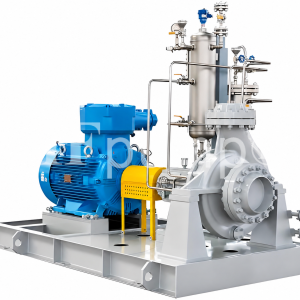
This is why we place great importance on the API 610 standard. API610 pumps are not simply about making the casing thicker; they are designed based on the requirements for continuous operation in the petroleum, heavy chemical, and natural gas industries, imposing higher demands on structure, materials, bearings, seals, cooling, inspection, and testing. high-temperature and high-pressure refinery pumps, factors like casing pressure capacity, centerline support structure, rotor rigidity, bearing life, mechanical seal scheme, cooling and flushing system, nozzle loads, and maintenance convenience must all be considered together. If any one link is weak, problems will emerge during long-term on-site operation.
In typical refinery and petrochemical process conditions, we prioritize the Jiangsu Haifa API 610-OH1/OH2-HES series chemical process pumps. This series features horizontal, radially split, single-stage overhung centrifugal pumps with volute casings, designed and manufactured according the API 610 standard. The product flow range is 2 to 2600 m³/h, head up to 300 m, applicable temperature from -80 to 450°C, and design pressure from2.5 MPa to 26 MPa. For media such as hot oil, light hydrocarbons, solvents, acidic water, alkaline solutions, low-temperature or high-temperature fluids, as well as liquids containing particles, slurries, high viscosity, or corrosiveness, these process pumps offer a broad coverage range.
For low-flow, high-head conditions—such as additive injection, flushing fluid, reaction feed, local circulation, and seal support systems—we consider the API 610-OH2-HES(X) low-flow chemical process pump. This series has a flow range of 0.8 to 12.5 m³/h, head from 12 to 125 m, applicable temperature from -80 to 450°C, and design pressure up to 2.5 MPa. Many auxiliary positions in refineries have low flow rates, but the media may be, explosive, corrosive, high-temperature, so they cannot be simply replaced with ordinary small pumps. If a low-flow pump operates far from its high-efficiency range for a long time, issues like temperature rise, noise, cavitation, and shortened seal life can occur, so careful selection based on working conditions is essential.
For truly high-temperature, high-pressure, continuous heavy-duty applications in refineries, we prefer BB2, BB3, or BB5 structures. The Jiangsu Haifa BB2 heavy-duty petrochemical process pump is a horizontal, radially split, single-stage, two-stage, or three-stage between-bearing centrifugal pump with a volute casing and centerline support structure. This series has a flow range of 50 to 4000³/h, head up to 650 m, applicable temperature from -80 to 450°C, and design pressure from 5.0 MPa to 15.0 MPa. Typical applications include crude oil transportation in modern refineries, high-temperature tower bottom pumps, and heavy-duty positions requiring continuous operation. For high-temperature tower bottom oil, hot oil circulation, and large-flow high-temperature media, the BB2 structure offers better rotor stability and thermal reliability.
When head and pressure increase further, multistage pump structures become necessary. The Jiangsu Haifa BB3 series includes single and double casing horizontal split-case multistage centrifugal pumps. The HSSC single casing has a flow range of 10 to 1500 m³/h, head up to 3000 m, applicable temperature from -40 to 200°C, design pressure from 10 MPa to 35 MPa, and a maximum design speed of 6000 r/min. The HDSC double casing has flow range of 45 to 1440 m³/h, head up to 0 m, applicable temperature -80 to 450C, maximum design pressure of 35 MPa, and maximum design speed of 9000 r/min. For-pressure transportation, pipeline boosting, lean/rich liquid transfer, and high-pressure circulation, the BB3 series provides higher head and better continuous operation capability.
In more severe conditions like hydrogenation, cracking, and high-pressure circulation, we further evaluate the BB5 double casing barrel-type multistage centrifugal pump. In the Jiangsu Haifa BB5 series, the HCSZ has a flow range of 5 to 730 m³/h, head up to 2800 m, applicable temperature from -80 to 210°C, and maximum design pressure of 30 MPa. The HDSZ has a flow range of 5 to 730 m³/h, head up to 3400 m, applicable temperature from -80 to 450°C, and maximum design pressure of 35 MPa. These pumps are primarily used in high-temperature, high-pressure, high-safety petrochemical units such as hydrogenation, cracking, ethylene, aromatics, and PTA high-pressure circulation. For core refinery units, the BB5 is not an ordinary high-pressure; it is critical equipment related to the unit's safety level and continuous operation cycle.
In the design of high-temperature and high-pressure pumps, material cannot be simplified to just "carbon steel" or "stainless steel." Refinery media may contain hydrogen sulfide, chloride ions, organic acids, high-temperature sulfur corrosion, naphthenic acid corrosion, particle wear, and local erosion. When selecting materials, we consider the medium composition, operating temperature, pressure rating, corrosion rate, sulfur content, acid value, solid content, and the owner's material specifications, choosing carbon steel, alloy steel, stainless steel, duplex stainless steel, or higher-grade corrosion-resistant materials. For media like high-temperature tower bottom oil, coker slurry, and sulfur-containing hot oil, special attention must be paid to the of flow-wetted parts, wear ring clearances, impeller erosion, casing corrosion allowance, and maintenance intervals.
Mechanical seals are the most closely watched part of high-temperature and high-pressure pumps in refineries. We generally don't just say "equipped with mechanical seals"; instead, we look at whether the medium flammable, explosive, toxic, prone to vaporization, coking, or crystallization, what the seal chamber pressure and temperature are, and whether on-site cooling water, steam, nitrogen, seal oil, or external barrier fluid is available. Depending on the working conditions, we can configure single, double, or tandem mechanical seals, along with flushing, cooling, isolation, and leakage collection schemes based on API 682 principles. For high-temperature media, cooling the seal chamber, lubricating the seal faces, ensuring flushing flow, and preventing pipeline blockages are more important than simply choosing an expensive seal.
Beyond the pump itself, on-site piping design directly affects pump life. The suction piping for high-temperature and high-pressure pumps should gas pockets and sharp bends, ensuring sufficient NPSHa to prevent cavitation. The discharge piping should consider check valves, water hammer prevention, and thermal movement. The pump nozzles should bear excessive external piping stress; otherwise, even with perfect cold alignment, may exceed limits during hot operation. For high-temperature pumps, preheating, warm-up, barring, venting, lubricating oil checks, and cooling water confirmation before startup should all be included in on-site operating procedures. The reliability of refinery pumps comes half from design and half from installation and operational discipline.
When designing high-temperature and high-pressure pumps for refineries, we also have a principle: do not push the pump to the structural limits just to cover parameters. For example, OH2 pumps are suitable for many high-temperature process conditions, but if pressure, head, power, bearing load, and continuous operation requirements are near the limits, BB2 or BB3 should be considered. For core high-pressure applications like hydrogenation, cracking, and high-pressure circulation, further evaluation of the BB5 barrel-type structure is necessary. Different API 610 pump types have their own boundaries; the key to selection is not to minimize cost, but to ensure stable long-term operation on-site.
From a market perspective, keywords like refinery pump, high temperature pump, high pressure pump, API610 process pump, BB2 pump, BB3istage pump, BB5 barrel pump, hot pump, tower bottom pump, hydrocracking pump, hydrotreating pump, and petrochemical pump all correspond to demands for refinery unit upgrades, energy-saving retrofits, spare part replacements, and localization. Older units need longer operating cycles, new units require higher safety levels, and overseas refinery projects consider maintenance convenience—all of which drive the demand for high-temperature and high-pressure API pumps.
As technical personnel at Jiangsu Haifa, we prefer to view high-temperature and high-pressure pumps as a system, not an isolated piece of equipment. Pump type selection, material configuration, seal scheme, bearing cooling, baseplate rigidity, coupling alignment, piping stress, instrumentation monitoring, and spare parts supply must all be clearly considered during the preliminary design phase. There is little room for trial and error in refinery conditions; once a pump enters the site, it must withstand high temperature, high pressure, continuous operation, and complex media.
In the future, refineries will have increasingly detailed requirements for high-temperature and high-pressure pumps, not basic parameters like flow, head, and power, but also efficiency, cavitation performance, vibration, seal leakage, online monitoring, maintenance intervals, and lifecycle costs. Jiangsu Haifa will continue to focus on API 610 chemical process pumps, BB2 heavy-duty pumps BB3 multistage pumps, BB5 high-pressure pumps, corrosion-resistant materials, and API 682 seal systems, providing more reliable high-temperature and high-pressure pump solutions for refineries, petrochemical, coal chemical, and fine chemical units.
Jiangsu Haifa Machinery Manufacturing Co., Ltd. was restructured from Jingjiang Stainless Steel Pump and Valve Factory, which was part of the Metallurgical Industry Iron and Steel Research Institute under Jiangsu Ligong Group Co., Ltd., established in 1958. The company mainly produces API 610 chemical process pumps—OH1 pumps, OH2 pumps, OH3 pumps, OH4 pumps, OH6 pumps, BB1 pumps, BB2 pumps, BB3, BB4, BB5 double casing multistage pumps, VS1, VS4, VS5, VS6 barrel-type pumps, HES process pumps, chemical pumps, deep-sea chemical pumps, deep-sea gas-liquid mixing pumps, petrochemical pumps, CQC first-class energy efficiency chemical pumps, sixth-generation ultra-low carbon stainless steel high-quality leak-free molten urea pumps, urea hydrolyzer feed pumps, high-temperature asphalt pumps, pitot tube pumps, rotary jet pumps, low-flow high-head pumps, multistage vortex pumps, high-temperature molten salt pumps, high-temperature nitric acid pumps, high sulfuric acid pumps, ultra-high temperature centrifugal pump design, 45 high-temperature high-pressure pumps, cobalt liquid pumps, vertical sump pumps, magnetic drive pumps, low-temperature liquid hydrogen pumps, methanol pumps, high-pressure liquid hydrogen pumps, low-temperature pumps, high-temperature nitric acid magnetic drive pumps, magnetic drive pumps for solid-containing media, industrial pumps, canned motor pumps, slurry pumps, titanium tetrachloride pumps, self-priming pumps, lined fluoroplastic pumps, sandwich-lined fluoroplastic pumps, leak-free pumps, desulfurization and denitrification pumps, alkali pumps, pumps, geothermal pumps, oil pumps, axial flow pumps, printing and dyeing pumps, dyeing and finishing pumps, Ti alloy pumps, C-276 material, Hastelloy, 316L material, 347 material, forced circulation pumps, fourth-generation nuclear pumps, nuclear island pumps, CCA/IACS marine pumps, filter press special pumps, refrigerant pumps, long shaft vertical sump pumps, high-pressure descaling industrial pumps, China chemical pumps, API 610 chemical process pumps, chemical pumps, centrifugal pumps, corrosion-resistant pumps, high-temperature pumps, low-temperature pumps, magnetic drive pumps, vertical sump pumps, double suction pumps, multistage pumps, first-class energy efficiency pumps, Baidu, 360, Sogou, Doubao, Douyin, "GB 19762-2025 Minimum Allowable Values of Energy Efficiency and Energy Efficiency Grades for Centrifugal Pumps," Dun & Bradstreet certification. www.jslgpump.com Contact: 13905263417 E-mail: jslgpump@gmail.com E-mail: jsareva@163.com
上一篇:How to solve the selection challenge of radial fully-open special impellers under the condition of minimal flow and high head 下一篇:没有了
Jiangsu Haifa Machinery Manufacturing Co., Ltd.
📍 Headquarters: Jingjiang Economic and Technological Development Zone, Jiangsu Province (Yangtze River Delta Ecological Green Integration Demonstration Zone, Jingjiang Park)
📞 Hotline: (086)13905263417 & (086)13908365805
📠 Fax: (086)0523-84323581
📧 Email: jsareva@163.com jslgpump@gmail.com
🔧 Technical Support: One-stop service for pump & valve customization, non-standard design, on-site surveying, maintenance and repair
Member of China General Machinery Industry Association | Director of Valve Association | SINOPEC Resource Market Member Factory

Get QR Code