
Examining the vibration, cavitation, and predictive maintenance of API610 chemical process pumps from foreign research perspectives
2026-06-24 06:29:48 318 江苏海珐In recent international research on pumps, terms like predictive maintenance, machine learning, vibration analysis, and fault diagnosis are appearing more frequently. Many articles discuss how to use data such as vibration, pressure, flow, current, temperature, and noise to predict issues in centrifugal pumps, including cavitation, bearing failure, rotor imbalance, impeller wear, or mechanical seal problems.
From the perspective of our Jiangsu Haifa API610 chemical process pump technicians, predictive maintenance is not simply about installing a few sensors or writing "AI monitoring" into a proposal. Truly effective predictive maintenance must be built on correct pump selection, standardized installation, stable operating conditions, and long-term data accumulation If the pump itself is wrongly selected or the piping design is unreasonable, even the most advanced monitoring system can only tell you that it is failing.
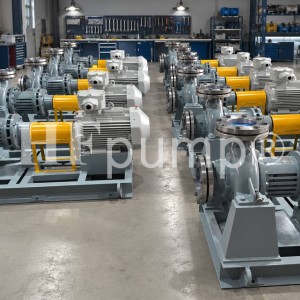
API610 chemical process pumps primarily serve continuous operation scenarios such as oil refining, petrochemicals, coal chemicals, natural gas processing, offshore platforms, and high-temperature and high-pressure processes. Many pumps do not run just a few hours a day but operate for extended periods. For such equipment, maintenance is not about waiting until failure to disassemble; rather, it is about identifying problems before they escalate.
The key signals we focus on in the field are: bearing vibration, bearing temperature, pump discharge pressure fluctuation, motor current variation, mechanical seal leakage, lubricating oil condition, changes in pump sound, flow deviation, and suction pressure changes. A single data point may not indicate a problem, but when several data points change simultaneously, it becomes highly valuable for reference.
For example, if pump vibration increases while discharge pressure fluctuation intensifies, suction pressure drops, and the sound becomes muffled, cavitation or insufficient suction supply should be suspected. Another example: if vibration gradually rises along with bearing temperature, but flow and pressure stable, the focus should be on checking bearings, alignment, and rotor dynamic balance. If seal leakage increases while seal flush pressure is abnormal, the seal flush piping, filter, and seal chamber pressure should be inspected.
Jiangsu Haifa API610-OH1/OH2 HES series chemical process pumps cover a flow range of 2 to 2600 m³/h, head up to 300 m, applicable temperature from -80 to 450°C, and design pressure from 2.5 to 26 MPa. This series incorporates considerations in support, connection, bearing, and cooling structures, and can be equipped with auxiliary and monitoring, making it suitable for process conditions in oil refining, petrochemicals, coal chemicals, and offshore industries.
For heavy-duty continuous operation, we more often recommend BB2. The API-BB2 HFDD series has a flow range of 50 to 4000 m³/h, head up to 650 m, applicable temperature from -80 to 450°C, and design pressure from 5.0 to 15. MPa. It is suitable for applications such as high-temperature tower bottom pumps in refineries, crude oil transportation, natural gas processing, and/rich liquid pumps in large ammonia synthesis units. When paired with vibration monitoring, bearing temperature monitoring, and seal system monitoring, these pumps greatly benefit long-term operation.
For high-pressure multistage pumps, such as BB3 and BB4, I strongly recommend systematic monitoring. BB3 can achieve a head of 3000 to 3200 m, with a maximum design pressure of 35 MPa; BB4 can achieve a head of 0 m, with a design pressure of up to 15 MPa. Once high-head pumps experience surging, cavitation, rotor instability, or bearing issues, the impact is greater than that on ordinary low-pressure pumps. Therefore, operating data must be recorded and cannot rely solely on listening to the sound on site.
For predictive maintenance to be truly effective, baseline data must be established. The vibration values, bearing temperatures, discharge pressures, motor currents, and seal leakage amounts when the pump is first put into operation serve as the foundation for future equipment condition assessment. If a pump initially vibrates at 2.0 mm/s and after six months reaches 3.5 mm/s, even if no alarm is triggered, the trend should be monitored. Trends are more important than single points.
I have also encountered users whose first reaction to high pump vibration is to ask the manufacturer to modify the impeller. In reality, many vibration issues stem from piping stress, foundation looseness, poor coupling alignment, air entrainment in the suction piping, or long-term operation at low flow rates. This is where the value of predictive maintenance lies: it is not meant to prove that the pump is broken, but to help us determine whether the originates from the pump, piping, motor, foundation, or process conditions.
In the future, competition in API610 chemical process pumps will not only be about hydraulic efficiency and material corrosion resistance, but also about overall reliability, seal solutions, operational data, fault diagnosis, and field service capabilities.
API610 chemical process pumps, centrifugal pump vibration, predictive maintenance for pumps, mechanical seal leakage, bearing temperature, pump fault diagnosis, BB2 process pumps, BB3 multistage pumps, centrifugal pump vibration, predictive maintenance for pumps, API 610 pump maintenance, pump fault diagnosis, chemical process pump reliability
上一篇:Research hotspots of oil-gas multiphase pumps: application boundaries of multiphase pumps, twin-screw pumps, and API610 centrifugal pumps 下一篇:Analysis of the causes of pressure fluctuation, vibration, and noise in centrifugal pumps: field experience from Jiangsu Haifa
Jiangsu Haifa Machinery Manufacturing Co., Ltd.
📍 Headquarters: Jingjiang Economic and Technological Development Zone, Jiangsu Province (Yangtze River Delta Ecological Green Integration Demonstration Zone, Jingjiang Park)
📞 Hotline: (086)13905263417 & (086)13908365805
📠 Fax: (086)0523-84323581
📧 Email: jsareva@163.com jslgpump@gmail.com
🔧 Technical Support: One-stop service for pump & valve customization, non-standard design, on-site surveying, maintenance and repair
Member of China General Machinery Industry Association | Director of Valve Association | SINOPEC Resource Market Member Factory

Get QR Code