
Correct usage and preheating requirements for high-temperature pumps in asphalt projects
2026-06-07 06:41:51 359 江苏海珐In asphalt production, storage and transportation, modified asphalt units, road construction, and chemical heat transfer oil systems, high-temperature are essential equipment for conveying high-temperature asphalt, heavy oil, heat transfer oil, and high-viscosity media Due to the characteristics asphalt, such as high, high viscosity, easy solidification, and easy coking, attention must be paid to preheating, insulation, sealing, and start-stop operations during the use of high-temperature pumps; otherwise, problems such as pump blockage, mechanical seal failure, motor overload, and excessive bearing temperature rise may occur.
Why does a high-temperature asphalt pump need preheating? Asphalt has poor fluidity at room temperature and easily solidifies when the temperature drops. When the pumped fluid temperature exceeds 150°C, it is recommended to fully preheat the high-temperature pump before starting. Especially for equipment such as asphalt pumps, heavy oil pumps, and-temperature heat transfer oil pumps, if the temperature difference between the pump body and the medium is too large, thermal shock can cause thermal deformation of components like the pump body, pump cover, shaft sleeve, and mechanical seal, affecting the pump's operational stability. The pump type is generally selected as API610 ZA/ZE/OH2 pumps. The main functions of preheating include: reducing asphalt viscosity to improve medium fluidity; preventing cold pumps from directly contacting-temperature media and causing thermal shock; preventing asphalt from solidifying in the pump chamber, seal chamber, and pipelines; reducing starting torque to prevent motor overload; and extending the service life of mechanical seals, bearings, and shafts. Therefore, in asphalt projects, high-temperature pumps cannot be started cold and must be preheated and insulated according to on-site process requirements.
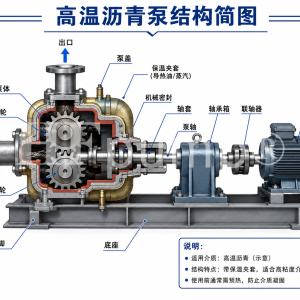
Preheating methods for jacketed high-temperature pumps In high-temperature asphalt conveying systems, commonly used high-temperature pumps often adopt a jacketed insulation structure. Jacketed high-temperature pumps can be preheated using steam, thermal oil, or electric heating to warm the pump body, pump cover, and seal chamber, ensuring the medium inside the pump remains in a good flow state.
1. Steam jacket preheating: The steam jacket is a common preheating method for asphalt pumps, suitable for asphalt stations, chemical plants, and refining projects with steam pipelines. After steam enters the pump jacket, it can quickly raise the pump body temperature, preventing asphalt condensation and blockage. When using steam preheating, attention should be paid to: not allowing steam pressure to be too high to prevent excessive jacket pressure; draining condensate before; ensuring the preheating process is slow and uniform; and continuing insulation after pump shutdown to prevent residual asphalt solidification. 2. Thermal oil jacket preheating: Thermal oil preheating is suitable for high-temperature continuous operation conditions, with more stable temperature control, and is ideal for conveying modified asphalt, heavy asphalt, and high-temperature chemical media. The thermal oil jacket can make the pump body temperature more uniform, reducing issues of local overheating or excessive temperature differences. For long-term continuous operation of high-temperature asphalt pumps, the thermal oil jacket is a relatively stable and reliable insulation method. 3. Electric heating preheating: Electric heating is suitable for small asphalt conveying devices without steam or thermal oil systems on site. Electric heating is easy to install and simple to control, and can be used for auxiliary insulation of the pump body, pipelines, and valves. However, electric heating requires attention to explosion-proof ratings, temperature control protection, and electrical safety to avoid local overheating causing asphalt coking or safety hazards.
Precautions before starting a high-temperature asphalt pump Before starting a high-temperature asphalt pump, the following should be checked: whether the pump body pipelines, and valves are fully preheated; whether the inlet valve is fully open; whether the outlet valve is at a reasonable opening; the pump chamber is filled medium, with no dry running allowed; whether the coupling guard is properly installed; whether the mechanical seal cooling or flushing system is normal; whether the bearing box lubricating oil meets requirements; whether the motor rotation direction is correct; and whether the jacket steam, thermal oil, or electric heating system is operating normally. For high-viscosity asphalt media, the inlet pipeline should also be confirmed to be unobstructed before startup to avoid pump cavitation, vibration, or dry grinding due to insufficient suction.
Key checks during high-temperature pump operation After the high-temperature asphalt pump is running, flow rate, pressure, current, vibration, noise, bearing temperature, and seal leakage should be regularly checked. If the outlet pressure abnormally increases, it may be due to pipeline blockage, unopened valves, or increased viscosity from low asphalt temperature; if the motor current is too high, it may be due to excessive medium viscosity, internal pump friction, or insufficient starting temperature. During operation, the jacket insulation system should be kept stable to prevent local cooling of the pump body. Especially in intermittent operation asphalt projects, if the pump is stopped for a long time, insulation should be maintained to prevent asphalt in the pump chamber from cooling and solidifying, which could cause difficulty in the next startup.
Insulation and cleaning after pump shutdown After a high-temperature asphalt pump is shut down, it is not recommended to immediately stop the jacket heating. Steam, thermal oil, or electric heating should be continued for a period based on on-site conditions to prevent residual asphalt in the pump from solidifying. If the system needs to be shut down for a long time, the asphalt in the pump body and pipelines should be promptly drained, and if necessary, suitable media should be used for purging or cleaning. Before long-term shutdown, the following should be addressed: draining residual asphalt from the pump chamber; cleaning filters and low points in pipelines; checking for coking on the mechanical seal; maintaining the pump shaft, bearings, and coupling; and performing drainage and anti-corrosion treatment on the jacket system.
Recommendations for selecting high-temperature pumps in asphalt projects When selecting high-temperature pumps for asphalt projects, the choice should be comprehensively determined based on flow rate, head, temperature, viscosity, working pressure, operation mode, and on-site insulation conditions. For high-temperature, high-viscosity asphalt, jacketed high-temperature asphalt pumps are recommended; for continuous circulation conveying, high-temperature centrifugal pumps can be selected; for low flow, high pressure, high viscosity conveying, high-temperature gear pumps or rotor pumps can be chosen. In terms of sealing, high-temperature asphalt pumps should prioritize high-temperature-resistant mechanical seals, metal bellows mechanical seals, or packing seal structures. For conditions with high environmental requirements and media prone to coking, double mechanical seals with a barrier fluid system can be used to improve operational reliability.
Summary In asphalt projects, the stable operation of high-temperature pumps depends not only on the's structural design but also on correct on-site operation. For high-temperature media such as asphalt, heavy oil, and heat transfer oil above 150°C, preheating is recommended before startup. Jacketed high-temperature pumps can be preheated using steam, thermal oil, or electric heating to ensure uniform temperature of the pump body, pump cover, and seal chamber, preventing asphalt solidification and coking. Correct preheating, insulation, startup, and shutdown operations can effectively improve the operational stability of high-temperature asphalt pumps, reduce mechanical seal damage, lower the risk of motor overload, and extend equipment service life. For asphalt conveying systems, modified asphalt production lines, and high-temperature chemical projects, selecting the appropriate high-temperature pump and strictly implementing preheating operations are important conditions for ensuring safe and continuous operation of the unit.
Jiangsu Haifa Machinery Manufacturing Co., Ltd. was restructured from Jiangsu Ligong Group Co., Ltd., founded in 1958, and the Jingjiang Stainless Steel Pump Valve Factory of the Central Iron and Steel Research Institute of the Ministry of Metallurgical Industry. It mainly produces API610 chemical process pumps - OH1 pumps, OH2 pumps, OH3 pumps, OH4 pumps, BB1 pumps, BB2 pumps, BB3, BB4, BB5 double casing multistage pumps, VS1, VS4, VS5, VS6 barrel pumps, HES type chemical process pumps, chemical pumps, deep-sea chemical pumps, deep-sea gas-liquid mixing pumps, petrochemical pumps, sixth-generation ultra-low carbon stainless steel high-quality leak-free molten urea pumps, urea hydrolyzer feed pumps, high-temperature asphalt pumps, Pitot tube pumps, rotary jet pumps, low-flow high-head pumps, multistage vortex pumps, high-temperature molten salt pumps, high-temperature nitric acid pumps, vertical sump pumps, magnetic drive pumps, low-temperature liquid hydrogen and methanol pumps, high-pressure liquid hydrogen pumps,-temperature pumps,-temperature nitric acid magnetic drive pumps, magnetic drive pumps for conveying solid-containing media, industrial pumps, canned motor pumps, slurry pumps, titanium tetrachloride pumps, self-priming pumps, lined fluoroplastic pumps, clamp-lined fluoroplastic pumps,-free pumps, desulfurization and denitrification pumps, alkali pumps, pumps, geothermal pumps, oil pumps, axial flow pumps, printing and dyeing pumps, dyeing and finishing pumps, Ti alloy pumps, C-276 material, Hastelloy, 316L material, 347 material, forced circulation pumps, fourth-generation nuclear power pumps, nuclear island pumps, CCA/IACS marine pumps, filter press special pumps, refrigerant pumps, long shaft vertical sump pumps, CQC first-class energy efficiency chemical pumps,-pressure descaling industrial pumps, Chinese chemical pumps, 01 "GB 19762-2025 Energy Efficiency Limit Values and Energy Efficiency Grades for Centrifugal Pumps", Dun & Bradstreet certification. www.jslgpump.com Contact number: 13905263417 E-mail: jslgpump@gmail.com E-mail: jsareva@163.com
上一篇:Overview of the development of China's water pump industry in 2026 下一篇:The mature application of high-temperature concentrated sulfuric acid pumps in concentrated sulfuric acid projects
Jiangsu Haifa Machinery Manufacturing Co., Ltd.
📍 Headquarters: Jingjiang Economic and Technological Development Zone, Jiangsu Province (Yangtze River Delta Ecological Green Integration Demonstration Zone, Jingjiang Park)
📞 Hotline: (086)13905263417 & (086)13908365805
📠 Fax: (086)0523-84323581
📧 Email: jsareva@163.com jslgpump@gmail.com
🔧 Technical Support: One-stop service for pump & valve customization, non-standard design, on-site surveying, maintenance and repair
Member of China General Machinery Industry Association | Director of Valve Association | SINOPEC Resource Market Member Factory

Get QR Code